Canadian visits are down 19%, but America’s most touristed state says California shares Canadian values, and is making the case for a comeback in 2026.
California will lose $700 million in 2025 due to a decline in Canadian visits, according to state tourism projections – a tide the Golden State is hoping to stem with more marketing and outreach to the travel trade.
Tourism officials from San Diego to Sonoma gathered in Toronto in early NOV25 to talk up new product and properties, showcase Canada-specific marketing campaigns, and offer reassurances to travellers wary of crossing the border.
“We’re here and we’re ready to roll out the red carpet for Canadian guests when they’re ready,” said Ryan Becker, Senior Vice President of Communications and Strategy for Visit California. The decline in visitors is “a bit of a gut punch and we’re very understanding of the reasoning behind it,” he told Open Jaw during a media presentation at Toronto’s Four Seasons Hotel. “This is really about making sure the relationships are strong, making sure the heart piece stays as strong as it can while the challenges are swirling around us.”
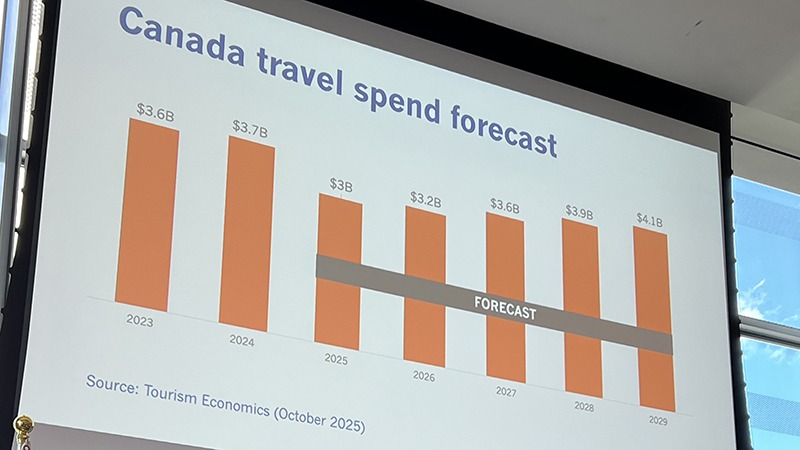
Before cross-border relations soured, 1.8 Canadians visited California and spent $3.7 billion in 2024, Becker said. In 2025, spending should be down to $1B. Led by B.C., Canadians made up the second most important international market for the state, second only to Mexico. The 19% decline is on par with the rest of the US, he added.
But recent internal polling shows that Canadians may be softening their attitudes toward visiting California, said Becker. And he was pleased that in conversations with local partners, tour operators and airlines said they too were seeing more bookings to the blue state. And Becker has in turn been able to assure tour operators that despite “lots of stories….the reality is for leisure travellers landing in a California airport, there has not been a single instance of someone getting detained or turned back” since the tariff tensions began.
“We understand that the level of passion and intensity around some of the rhetoric is starting to show some signs of waning,” he said. “We’re cautiously optimistic that this is the bottom for us.”
Visit California predicts that Canadian spending will climb to $3.2B in 2026, $3.6B in 2027, and by 2028 it will have more than made up the dip, at $3.9B.
Even in 2025, California received a confidence boost when a summer discount program on Expedia fared well: Canadians unlocked hotel discounts, and more than 26,000 rooms were booked in just two months.
More good news for the state’s travel trade: the iconic Highway 1 will reopen in March 2026 after being closed for three years. And California will host the next two Super Bowls, plus the 2028 Olympics, which will take place in Los Angeles.
Other highlights showcased by the Visit California team:
West Hollywood is a hot spot for night life, with over 300 restaurants, bars and clubs packed into a small, walkable space. It’s also fun for celebrity spotting – Tom Kiely, President and CEO of Visit West Hollywood, has seen the likes of Jennifer Aniston sitting at the table right next to his.
“We miss our Canadians terribly, but we know this is not a quick fix,” said Kiely, noting that in more normal times, the neighbourhood plays host to about 100,000 Canucks a year.
Just north of Santa Barbara, halfway down the coast between San Francisco and LA, the pretty seaside city of San Luis Obispo markets itself as SLO-CAL – where visitors can hike or bike along 300 trails, sample from 300 wineries, stay in oceanfront rentals, and explore the only beach in California that you can drive on. “We’re a younger area still developing,” said Cathy Cartier, President and CEO of Visit SLO-CAL. “We have some amazing product that’s equally good but just less well known.” Wine-tasting fees, she said, could be one-quarter what they are in more famous regions – and visitors will likely meet the vineyard owner. There are seven Michelin-starred restaurants in the region, and 3,000 additional rooms will be opening in the next few years, many in boutique properties.
Father south, Beverly Hills is not just Rodeo Drive, said Julie Wagner, CEO of the Beverly Hills Visitors and Convention Bureau. “There’s something for everybody – if you want the $30,000 dress or the Rolls Royce, we have that. Or bring your kids, go glamping, and get a vending-machine cupcake.” Celebrity sightings are common here too: Wagner has queued up for coffee with Roger Daltrey of The Who and Renee Zellweger.
Just 30 miles north of the Golden Gate Bridge lies hilly Sonoma County, prized for its 425 wineries. Although not yet as famous as Napa Valley (which you’ll pass along the way), tastings are also more affordable, said Claudia Vecchio, President and CEO of Sonoma County Tourism. The county also boasts an artisan cheese festival in March and a cheese trail where guests can see production up close. The county is also great for cycling. For kids, some wineries offer grape juice, and family activities like bocce ball. And there’s a Peanuts museum to commemorate cartoonist Charles Schulz, who lived there. Canadian visitors are an important international group, second only to the UK – and the decline has been felt. Vecchio estimates that “we’re down to double digits.”
Also very near to the City By the Bay is the intriguing region of San Francisco Penninsula. Nestled between the bay and the ocean, this lesser-travelled enclave includes Silicon Valley, with computer museums and Stanford University, and Half Moon Bay -- located right on Highway 1. The region has a genuine farm-to-table program that rewards local restaurants (25 of them are Michelin-starred) for using product from its 50 farms and fisheries. Just south of SFO, there are 140 hotels of all stripes, 60 miles of coastline and a dog surfing competition every August.