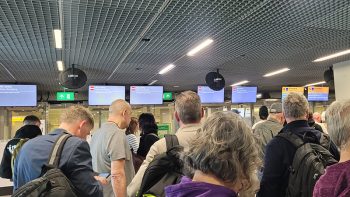
Another day, another development in the ongoing saga of the European Union’s biometric Entry/Exit System (EES).
Just days ago, Open Jaw reported that the International Air Transport Association (IATA) was calling for the flexibility measures in implementing EES to be extended until the system is fully operational. The association is looking to avoid a repeat of early summer lineups at airports across Europe.
Those measures, which allowed countries to pause EES checks, officially ended on 06SEP, raising concerns that more disruption could be on the way.
Now, the UK's Sunday Times reports at least nine countries have told the EU they won’t fully enforce the system until it’s working correctly.
France, Belgium, the Netherlands, Germany, Greece, Malta, Portugal, Italy and Switzerland have reportedly been given permission by Brussels officials to delay full implementation to “maintain border fluidity,” with no time limit put in place.
The European Commission, responsible for overseeing EES, “refused to comment,” having previously told ETIAS the system had “broadly worked well over the summer.”
EES was intended to replace traditional passport stamping for non-EU travellers entering the 29-country Schengen Area for stays of up to 90 days, including Canadians.
Instead, travellers must complete biometric registration, including a passport scan, photograph and fingerprint collection.
The system was introduced at select airports in October 2025 before becoming fully operational across the Schengen Area in April 2026. Countries were then given the option to temporarily pause the checks during the peak summer travel months.
The “safety valve,” as The Sunday Times calls it, was introduced following significant delays at some European airports.
The publication reports that many of the technical issues experienced at airports are still ongoing, leaving many of the multi-million dollar scanners unused and “gathering dust.”