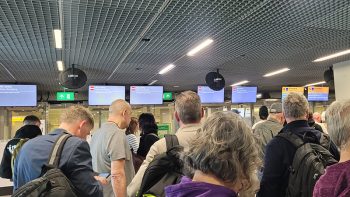
Officers at Canada’s transportation watchdog handle just one passenger complaint per day on average, according to sworn court testimony, a glacial pace that helps explain why the agency is now buried under a record backlog of more than 93,000 cases.
The CTA’s backlog swelled after air travel rebounded sharply in 2022, when airlines, short-staffed after pandemic layoffs, struggled to handle a flood of returning passengers. Flight disruptions triggered tens of thousands of compensation claims under Canada’s Air Passenger Protection Regulations.
The huge backlog emerged in evidence filed with the Ontario Superior Court as part of a constitutional challenge to rules that generally forbid passengers from publicly discussing complaints lodged with the Canadian Transportation Agency (CTA), as reported by The Globe and Mail.
Vincent Millette, Director of National Air Services Policy at Transport Canada, testified in October that each complaints resolution officer (CRO) at the agency “deals with one complaint every day” on average. His comment came during cross-examination by a lawyer for Air Passenger Rights, the advocacy group behind the challenge.
At that rate, even modest surges in complaints can overwhelm the system.
But the slow pace reflects more than sheer volume, according to testimony. It also stems from how Canada’s passenger-rights regime is structured.
Resolving a complaint is a legally binding, quasi-judicial process. Decisions can be challenged at the federal court through judicial review. As a result, cases often require extensive documentation and detailed legal analysis.
“Flight disruptions, which account for the highest volume of cases received, typically involve multiple overlapping causes,” said CTA spokesperson Jadrino Huot. Determining whether compensation is owed requires identifying the “most significant contributing factor” under federal regulations, a determination that can take time.
Airline submissions frequently run 80 to 100 pages, and sometimes far longer.
“There’s lots and lots of arguments, pages and pages of papers, sometimes hundreds, thousands of pages of paper,” said Gabor Lukacs, President of Air Passenger Rights. Often, he added, the dispute centres on about $400.
Once a passenger files a complaint online, the wait to begin the formal resolution process can exceed a year. After that, airlines are given time to respond. A CRO conducts an eligibility review and may facilitate mediation. If no settlement is reached, the officer must issue a binding decision within 90 days of the process formally starting.
Even that 90-day clock begins only after the file reaches the front of the queue. As reported by Open Jaw last week, an analysis of the CTA’s decisions database, conducted by legal tech firm Courtready, found that as of September 2025 the average time between a passenger’s flight and a final ruling had reached 987 days—nearly three years.
The number of CROs has grown, but a significant portion of the CTA’s budget—about 40%—is temporary, Huot told The Globe and Mail. At the time of Millette’s testimony, about 98 officers were handling cases. In October, there were 117, Huot said.
Even assuming roughly 100 officers working about 250 days a year, the math limits the agency’s capacity to the low tens of thousands of files annually, a constraint that helps explain why the backlog continues to swell.
In Europe, passenger compensation regimes are more straightforward, allowing many decisions to be rendered quickly using publicly available flight data. In Canada, by contrast, airlines can invoke broad exemptions—particularly when disruptions are deemed outside their control—triggering detailed debates over maintenance logs, staffing levels, and safety considerations.
Meanwhile, proposals to shift more of the financial burden of complaints onto airlines have stalled. In 2023, Parliament directed the CTA to implement a cost-recovery model requiring carriers to fund the system, with the agency proposing a fee of $790 per complaint. Federal efforts to finalize the framework, however, have yet to materialize.
Open Jaw reported, citing internal CBC documents, that senior Canadian government officials allegedly worked to delay the introduction of this airline-funded fee for air passenger complaint processing.
Without stronger incentives to settle early, critics say, airlines may have little reason to resolve disputes before they reach the regulator.